
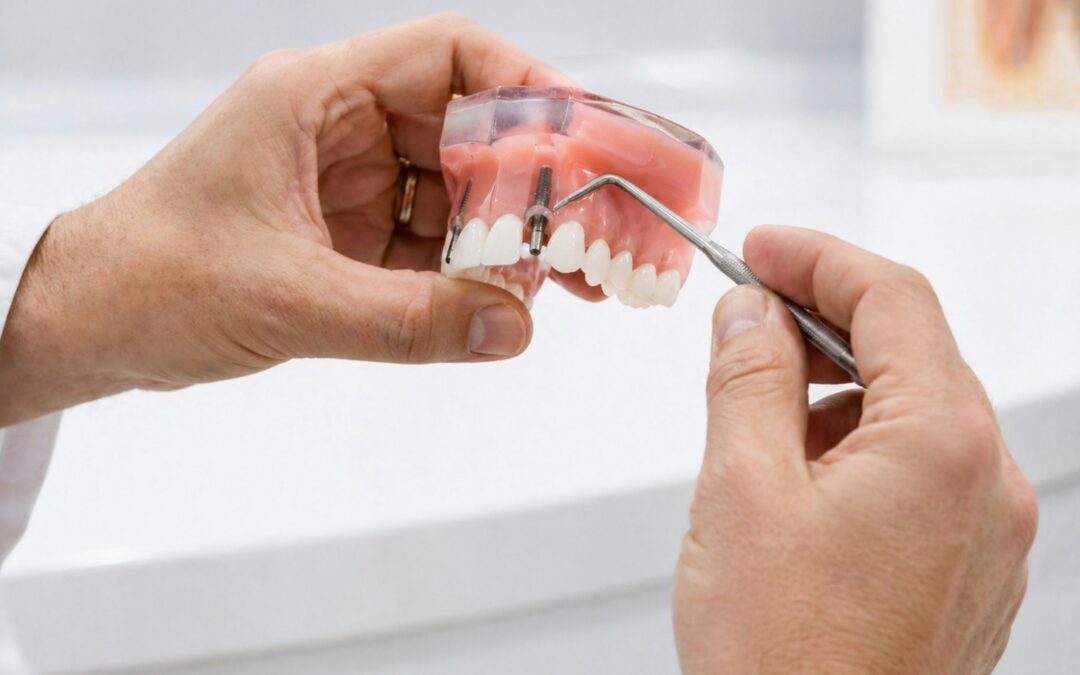
When several or all teeth are missing, dental implants can provide a stable foundation for restoring oral function, appearance, and confidence. Two commonly discussed approaches are traditional dental implants and All-on-4 implants. Although both use dental implants to support replacement teeth, they are designed for different clinical situations and restoration needs.
The primary difference in all-on-4 vs traditional dental implants involves the number and placement of implants, the type of restoration supported, and the number of teeth being replaced. Traditional implants can replace individual missing teeth or support bridges, while All-on-4 treatment is generally planned to support a complete fixed restoration for one dental arch.
When considering dental implants in Scottsdale, Arizona, we evaluate several factors before recommending an approach. Oral health, bone structure, the condition of remaining teeth, the number of missing teeth, bite, aesthetic goals, and overall treatment requirements all influence which implant solution may be appropriate.
What Are Traditional Dental Implants?
Traditional dental implants are designed to replace missing tooth roots and provide a foundation for replacement teeth. An implant is typically placed into the jawbone, where it can integrate with the surrounding bone. Once the implant has healed sufficiently, an abutment connects it to a restoration such as a dental crown.
For a single missing tooth, one implant can support one crown without requiring the adjacent natural teeth to serve as supports. This makes implant treatment a highly adaptable option for patients who have isolated missing teeth.
When several teeth are missing, multiple implants may be placed to support individual crowns or an implant-supported bridge. The number and positioning of implants depend on the location of the missing teeth, available bone, bite, and the design of the planned restoration.
During treatment planning for dental implants in Scottsdale, we assess the entire area rather than simply replacing the visible portion of a missing tooth. We consider the health of the gums, bone availability, neighboring teeth, bite relationship, and long-term restoration requirements.
An experienced implant dentist in Scottsdale can use these findings to develop an implant plan based on the specific teeth that need replacement.
What Are All-on-4 Dental Implants?
All-on-4 dental implants use strategically positioned implants to support a fixed full-arch restoration. The approach is generally intended for patients who have lost most or all of the teeth in one dental arch or whose remaining teeth are not suitable for long-term retention.
Rather than placing an individual implant for every missing tooth, all-on-4 implants typically use four implants to provide support for a full-arch prosthesis. The implants are positioned according to the available bone and the design of the final restoration.
This approach can provide a fixed solution for an entire upper or lower arch. The replacement teeth are connected as a unified restoration rather than being placed as separate individual crowns.
All-on-4 dental implant treatment may also be considered in situations where bone availability is limited in certain areas. Strategic implant positioning can sometimes allow treatment to be planned around areas with adequate bone. However, this does not mean that every patient with bone loss is automatically suitable for All-on-4 treatment. A clinical examination and appropriate imaging are necessary to determine whether the approach is appropriate.
The term full arch dental implants is often used when discussing this type of treatment because the objective is to restore an entire arch rather than isolated missing teeth. Depending on the patient’s circumstances, full mouth dental implants may involve treatment of both arches.
Interesting Read: 5 Essential Things to Know About All-on-4 Dental Implants
All-on-4 vs Traditional Dental Implants: Key Differences
Both approaches use dental implants, but their treatment objectives are different. We consider the following factors when comparing them.
1. Number of Implants
Traditional implant treatment may involve one implant for each missing tooth or several implants supporting an implant bridge. The number depends on the number and location of missing teeth and the planned restoration.
All-on-4 treatment typically uses four implants to support one complete arch restoration. The implants are strategically positioned to provide the necessary foundation for the prosthesis.
2. Teeth Being Replaced
Traditional implants are suitable for a wide range of tooth-loss situations. We may use them to replace one missing tooth, several missing teeth, or multiple teeth in different areas of the mouth.
All-on-4 treatment is primarily designed for patients who require replacement of most or all teeth in an arch. It provides a full-arch restoration rather than individual replacement teeth.
3. Treatment Process
Traditional implant treatment may involve tooth extraction, site preparation, implant placement, healing, abutment placement, and restoration. The sequence depends on the patient’s oral health and whether additional procedures are required.
All-on-4 treatment follows a full-arch treatment plan. When remaining teeth cannot be retained, extractions may be included as part of the overall rehabilitation. Implant placement and restoration are then planned around the complete arch.
Treatment timelines vary significantly. Bone healing, gum health, extractions, preparatory procedures, implant integration, and restoration design can all influence the overall schedule.
4. Bone Requirements
Available bone is an important consideration for any implant treatment. Traditional implants require sufficient bone in the planned implant location, although bone grafting or other preparatory procedures may sometimes be considered when bone volume is inadequate.
All-on-4 treatment uses strategically selected implant positions and may sometimes be planned for patients with reduced bone volume in certain regions. However, implant placement still requires appropriate anatomical support. We use clinical assessment and imaging to determine whether the available bone can support the proposed treatment.
5. Restoration Type
Traditional implants commonly support individual crowns or implant-supported bridges. This allows us to replace specific teeth while retaining healthy natural teeth elsewhere in the mouth.
All-on-4 supports a fixed full-arch prosthesis. The restoration is designed as a complete unit to replace the teeth throughout the treated arch.
Interesting Read: Types of Dental Implants: Single Tooth, Multiple Teeth, and Full Arch Options
All-on-4 vs Traditional Dental Implants Comparison
Comparing implant number, restoration type, bone requirements, treatment approach, and overall costs can help clarify how All-on-4 and traditional implants differ.
| Factor | All-on-4 Implants | Traditional Dental Implants |
| Best suited for | Full-arch tooth replacement | Individual or multiple missing teeth |
| Number of implants | Typically four per arch | Varies according to treatment |
| Restoration | Fixed full-arch prosthesis | Crowns, bridges, or other restorations |
| Treatment approach | Full-arch rehabilitation | Tooth-by-tooth or segment-based replacement |
| Bone considerations | May use strategically available bone | Bone volume influences implant placement |
| Customisation | Designed around the entire arch | Highly customisable for individual teeth |
| Cost | Depends on case and restoration | Depends on implant and restoration requirements |
This dental implants comparison shows why treatment cannot be selected simply by counting implants. The total treatment plan, restoration, preparatory procedures, and long-term requirements all need to be considered when comparing All-on-4 implants cost vs traditional implants.
Interesting Read: How Dental Implants Can Save You Money in the Long Run
All-on-4 Implants Cost vs Traditional Implants
Dental Implant treatment costs can vary considerably from one patient to another. The number of implants is only one part of the overall treatment expense.
For traditional implant treatment, costs may depend on the number of implants required, the type and number of crowns or bridges, diagnostic imaging, implant components, and any preparatory procedures.
With All-on-4 treatment, the overall cost includes the implant placement as well as the design and fabrication of the full-arch restoration. Materials, temporary and final prostheses, diagnostic procedures, extractions, and other treatments may also influence the total cost.
Additional factors can include:
- Number of implants required
- Type of final restoration
- Bone grafting or other preparatory procedures
- Tooth extractions
- Diagnostic imaging
- Implant and restorative materials
- Complexity of the case
- Number of arches being treated
- Laboratory and prosthetic requirements
For this reason, comparing the price of one traditional implant with an All-on-4 treatment package does not provide an accurate comparison of total treatment costs. A personalized treatment plan provides a clearer understanding of what is required.
Which Treatment is Right for You?
There is no single implant approach that is appropriate for every patient. We evaluate the condition of the mouth and the patient’s treatment objectives before recommending an implant restoration.
Traditional Dental Implants May Be Considered If:
- You have one or several missing teeth.
- You want individual tooth replacement.
- Your remaining natural teeth are healthy enough to retain.
- You need a customized solution for specific missing teeth.
- You have adequate bone or are a candidate for appropriate preparatory treatment.
- You prefer an implant-supported crown or bridge for selected areas.
Traditional implants can be particularly useful when we want to preserve healthy natural teeth while replacing only the teeth that are missing.
All-on-4 May Be Considered If:
- Most or all teeth in an arch are missing.
- Remaining teeth require removal because they cannot be predictably retained.
- You are seeking a fixed full-arch restoration.
- The available bone can support the planned implant positions.
- A complete arch rehabilitation is appropriate for your oral health and treatment goals.
A detailed examination is necessary before determining whether All-on-4 is suitable.
Benefits of Choosing Implant Dentistry
Choosing implant treatment involves more than selecting an implant system. Comprehensive planning helps ensure that the proposed restoration is based on the condition of the mouth and the patient’s individual needs.
- Comprehensive Implant Evaluation
Assess your teeth, gums, jawbone, bite, and overall oral health to develop an appropriate implant treatment plan. - Advanced Diagnostic Imaging
Digital and 3D imaging helps evaluate bone structure and surrounding anatomy for more precise implant planning. - Personalized Treatment Planning
Treatment is tailored to your oral health, number of missing teeth, bone condition, restoration needs, and smile goals. - Individual Tooth Replacement Options
Dental implants can replace individual missing teeth without requiring healthy neighboring teeth to support the restoration. - Full-Arch Implant Solutions
Implant-supported full-arch restorations can provide a fixed tooth replacement option for patients missing most or all teeth. - Improved Oral Function
Implant-supported restorations provide stable support for replacement teeth, helping improve chewing, biting, and speaking. - Natural-Looking Dental Restorations
Implant restorations can be designed to complement your existing teeth and smile for a natural-looking appearance.
Along with personalized implant treatment, our practice provides comprehensive dental services, including emergency dental care in Scottsdale, AZ, helping patients access timely care when unexpected dental concerns arise.
What to Expect During a Dental Implant Consultation
At Scottsdale Family Dentistry, an implant consultation with a dentist in Scottsdale, AZ begins with an assessment of your current oral health, treatment needs, and objectives.
The process may include:
- Dental and medical history review: We review relevant health information, previous dental treatment, medications, and concerns that may influence treatment planning.
- Examination of the teeth and gums: We evaluate remaining teeth, gum health, bite, and areas affected by tooth loss.
- Digital or 3D imaging: Appropriate imaging can help us evaluate the jawbone and important anatomical structures before implant placement.
- Bone assessment: We determine whether there is adequate bone in the proposed implant locations and whether additional procedures may be required.
- Treatment discussion: We explain suitable options, including traditional implants, implant-supported bridges, or full-arch approaches where appropriate.
- Timeline and cost discussion: We review the anticipated stages, healing periods, restoration requirements, and estimated treatment costs.
- Personalised treatment plan: The final plan is developed around the patient’s oral health, functional needs, aesthetic goals, and overall treatment requirements.
This process allows us to determine whether traditional implants or an All-on-4 approach is appropriate rather than selecting a treatment based solely on the number of implants.
Restore Your Smile With Personalised Implant Care
Replacing missing teeth involves more than choosing between two implant techniques. The appropriate solution depends on the number of teeth being replaced, the condition of the remaining teeth, bone availability, gum health, restoration requirements, and individual treatment goals.
At Scottsdale Family Dentistry, we can evaluate your oral health and discuss whether traditional dental implants, an implant-supported bridge, All-on-4 treatment, or another restorative option may be appropriate for your situation.
If you are considering dental implants in Scottsdale, a personalized consultation can provide a clearer understanding of your available treatment options, expected timeline, and restoration requirements.
Interesting Read: How to Care for Your Dental Implants: Tips for Long-Lasting Results
Ready to Explore Your Dental Implant Options?
Call Today to Schedule Your Appointment! Contact us at (480) 474-4990 to discuss your tooth replacement needs and explore which implant approach may be appropriate for your smile, oral health, and long-term dental goals.
Frequently Asked Questions About All-on-4 and Traditional Implants
What Is the Main Difference Between All-on-4 and Traditional Dental Implants?
Traditional implants can replace individual missing teeth or support bridges, while All-on-4 typically uses four strategically placed implants to support a fixed full-arch restoration.
Are All-on-4 Implants Better Than Traditional Dental Implants?
They are designed for different treatment situations. Traditional implants are commonly used for individual or multiple missing teeth, while All-on-4 is generally planned for full-arch tooth replacement. Suitability depends on the patient’s oral health and treatment needs.
How Many Teeth Can All-on-4 Implants Replace?
All-on-4 treatment is designed to support a complete arch of replacement teeth. One treatment can therefore replace the teeth throughout the upper or lower arch, depending on the treatment plan.
How Many Traditional Implants Are Needed for a Full Mouth?
There is no fixed number for every patient. The number depends on the condition of the mouth, available bone, planned restorations, and whether one or both arches require treatment.
Are All-on-4 Implants Suitable for Everyone?
No. The suitability of All-on-4 depends on factors including bone availability, gum health, overall oral health, remaining teeth, anatomy, and the ability to support the planned restoration.
Are All-on-4 Implants Less Expensive Than Traditional Implants?
The total cost varies by case. All-on-4 involves fewer implants but requires a full-arch restoration, while traditional implant treatment may involve multiple implants and individual crowns or bridges. A complete treatment plan is needed for an accurate comparison.
How Long Do All-on-4 and Traditional Dental Implants Last?
Implant longevity varies according to oral hygiene, gum health, bone support, bite forces, lifestyle factors, maintenance, and regular professional care. The implant and the restoration may also have different maintenance and replacement considerations.
Can Traditional Dental Implants Replace a Full Arch?
Yes. Multiple traditional implants can be used to support a full-arch restoration. The number and positioning of implants depend on the patient’s anatomy and the design of the planned restoration.
How Do I Know Which Implant Treatment Is Right for Me?
An implant consultation can help determine which approach is appropriate. We consider the number of missing teeth, remaining teeth, bone structure, gum health, bite, restoration goals, and overall oral health before developing a treatment plan.
How Can I Find a Dental Implant Specialist in Scottsdale?
When researching implant care, look for a dental practice that provides comprehensive examinations, appropriate diagnostic imaging, personalised treatment planning, and experience with both individual and full-arch implant restorations.


